Expat Eyes

This blog contains the photographs, observations and reflections of Rena Diana, an educator and writer, during extended stays in the Arabian Gulf, China, and Mongolia.

Archive for the month “March, 2012”

Windtowers to Skyscrapers


“To arrange three stones in a fireplace on which to set a pot was the only architecture that many of them required.”

Wilfred Thesiger

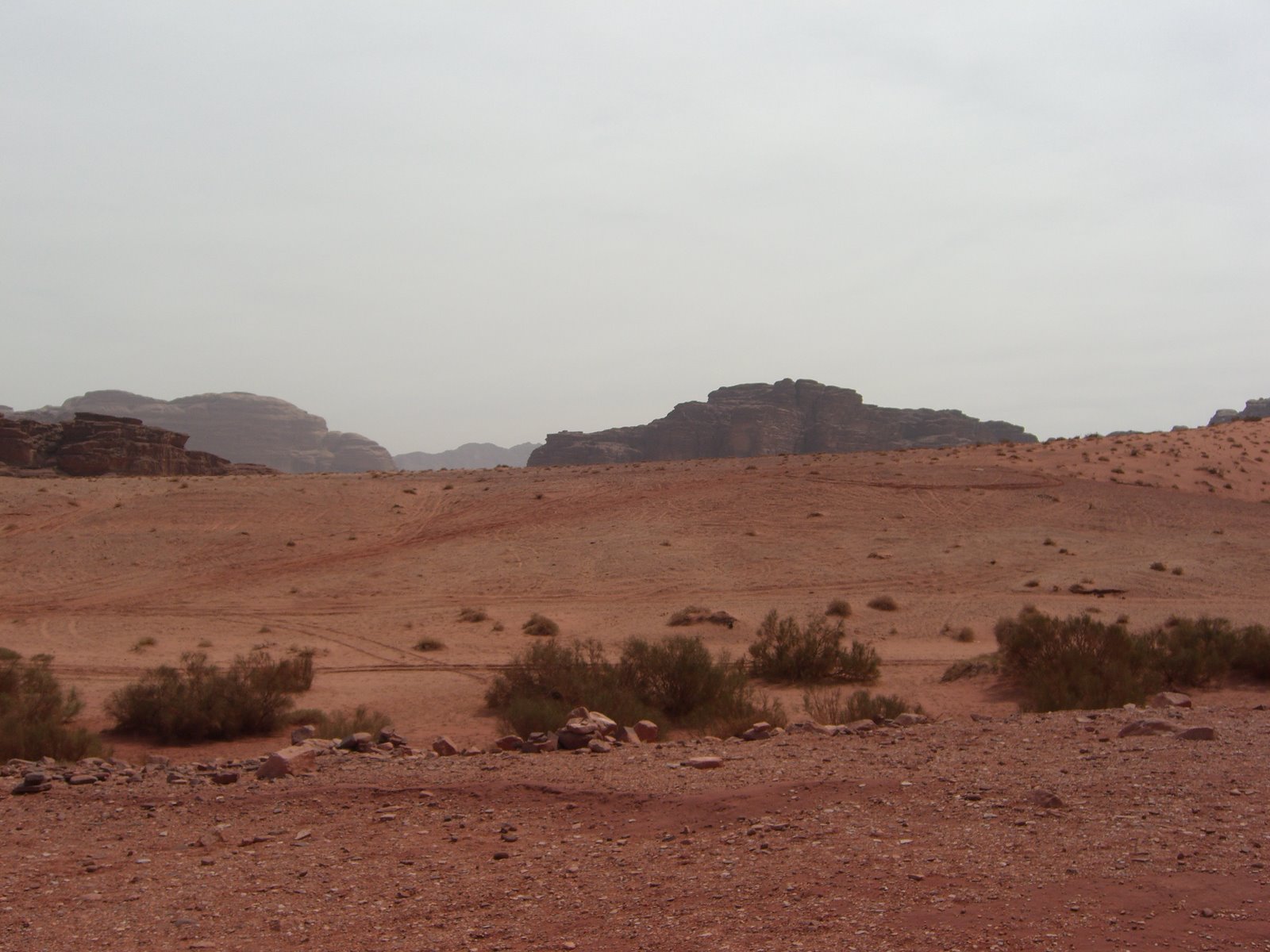
The Past: For centuries, the dwellings of Gulf Arabs were virtually non-existent. Home for Bedouins was where they slept that night, either under the stars or in simple tents of woven goat hair blankets. Royal families lived in more elaborate tent structures consisting of several “rooms” divided by drapes, made comfortable with thick carpeting and cushions. Modern desert camps for tourists resemble those traditional compounds.

The first distinctive architecture in Dubai appeared relatively recently, in the late 19th century. It was imported by merchants from a town in southern Persia called Basta, who were re-settling in the tiny fishing, pearl diving, and trading village of Dubai on the creek opening into the Persian (now Arabian) Gulf.  That creek is still simply called The Creek by the locals. The Persian immigrants built handsome homes with windtowers and courtyards, designed to adapt to the harsh desert climate. Green, sustainable architecture, before those terms were even used. I have never seen anything like them. They are stunning.
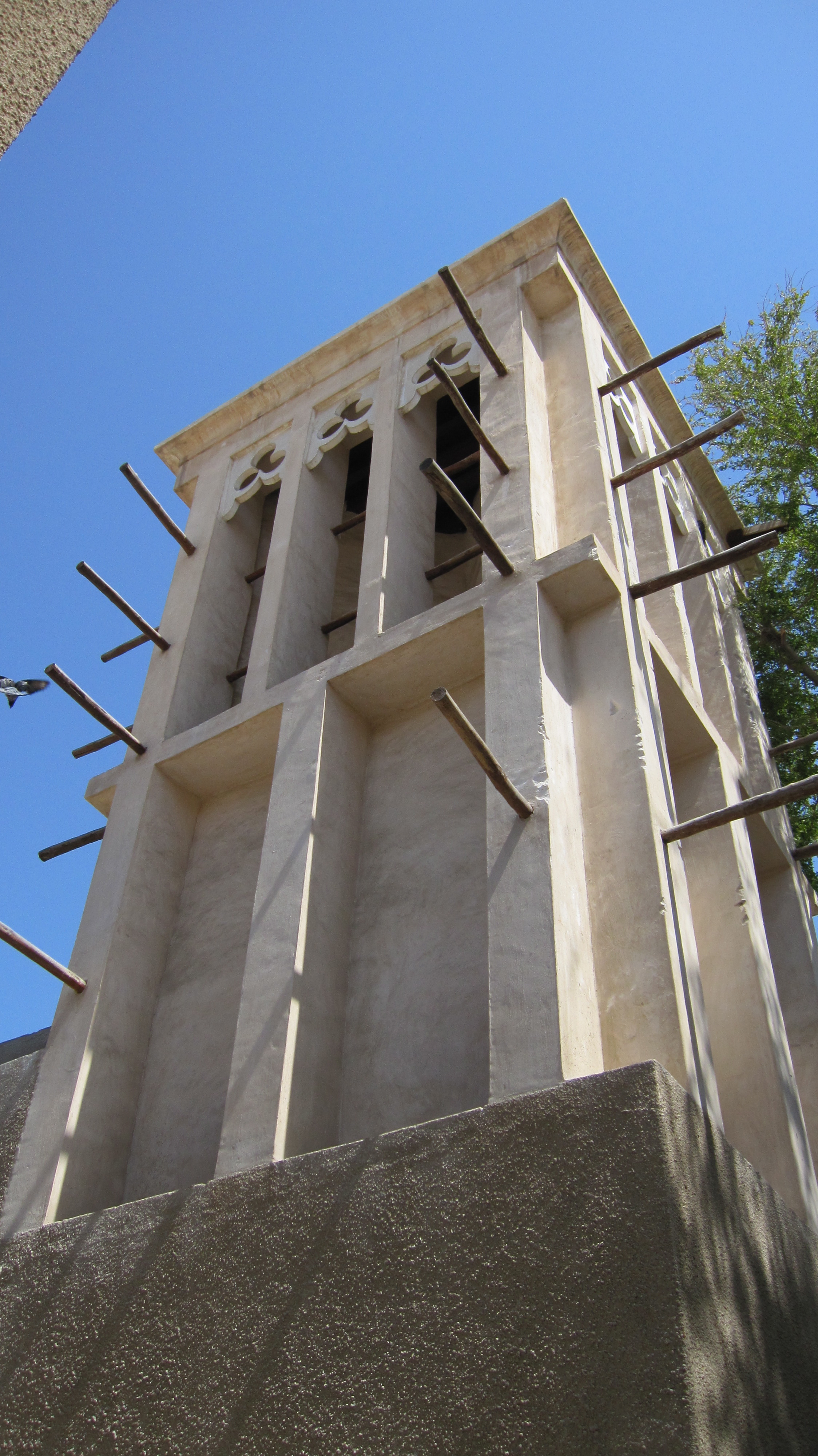
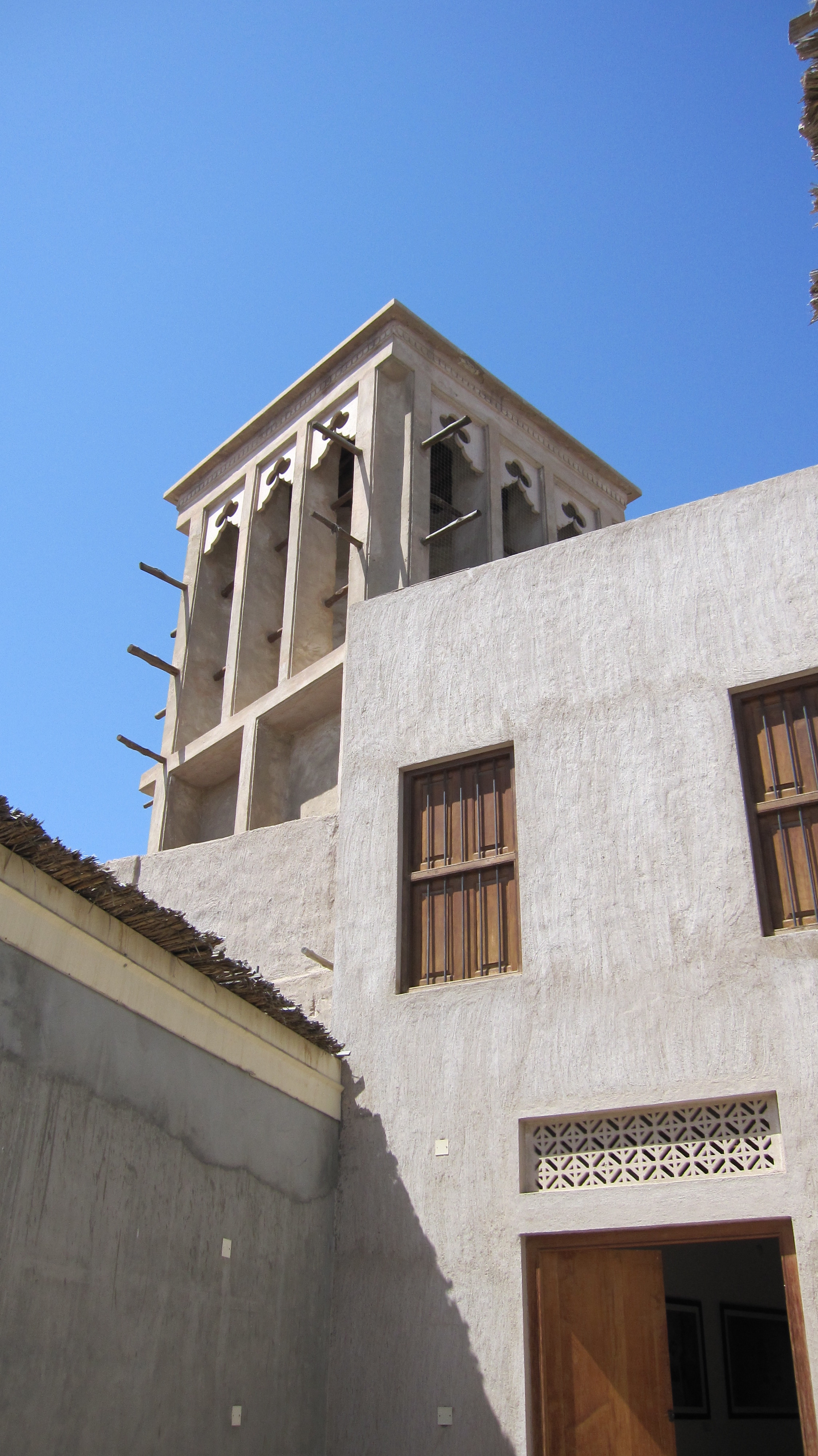
The windtowers are designed to capture the breezes from The Creek and the sea, funneling the air down to the rooms below.  The houses and towers are made of petrified coral blocks dug from The Creek and bonded with sarooj- a mixture of clay, manure, and water.  Ceilings and roofs are constructed around hardwood beams finished with a mixture of straw and silt. Since it rarely rains, the roofs are flat, providing another gathering and sleeping area for residents, depending on the season. They serve as exterior rooms, designed to maximize exposure to winds for cooling, as they are surrounded by perforated parapets. When it does rain, the run-off spills through spouts and can be collected for other purposes, such as  washing clothes or watering plants.

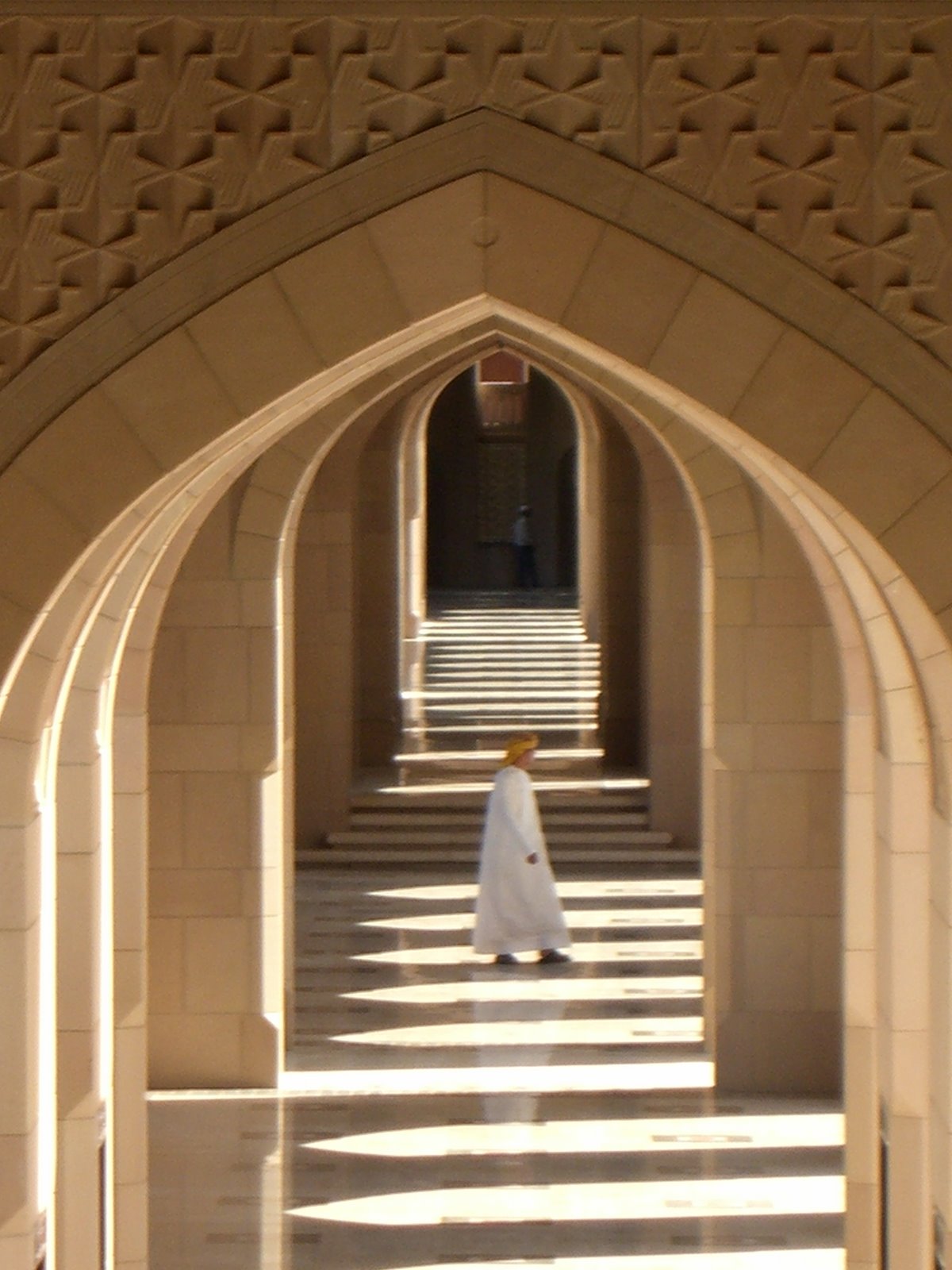
The elegant functional form of the windtowers is beautiful in itself. The Arabs, however, with their love of elaborate mosaics and decorative patterns, have added geometric and floral designs wherever they can.  Thus, there are finely carved ventilation screens, arches and balcony balustrades made from limestone slabs covered with chalk and water paste. Intricately carved wooden doors, with fanlight panels over them to diffuse the light and increase airflow, enhance the artistic effect. An intriguing side note: the stone balconies on traditional homes in the Middle East, with Arabesque motifs cut into them, are meant to both let in air AND to conceal the women sitting on them.


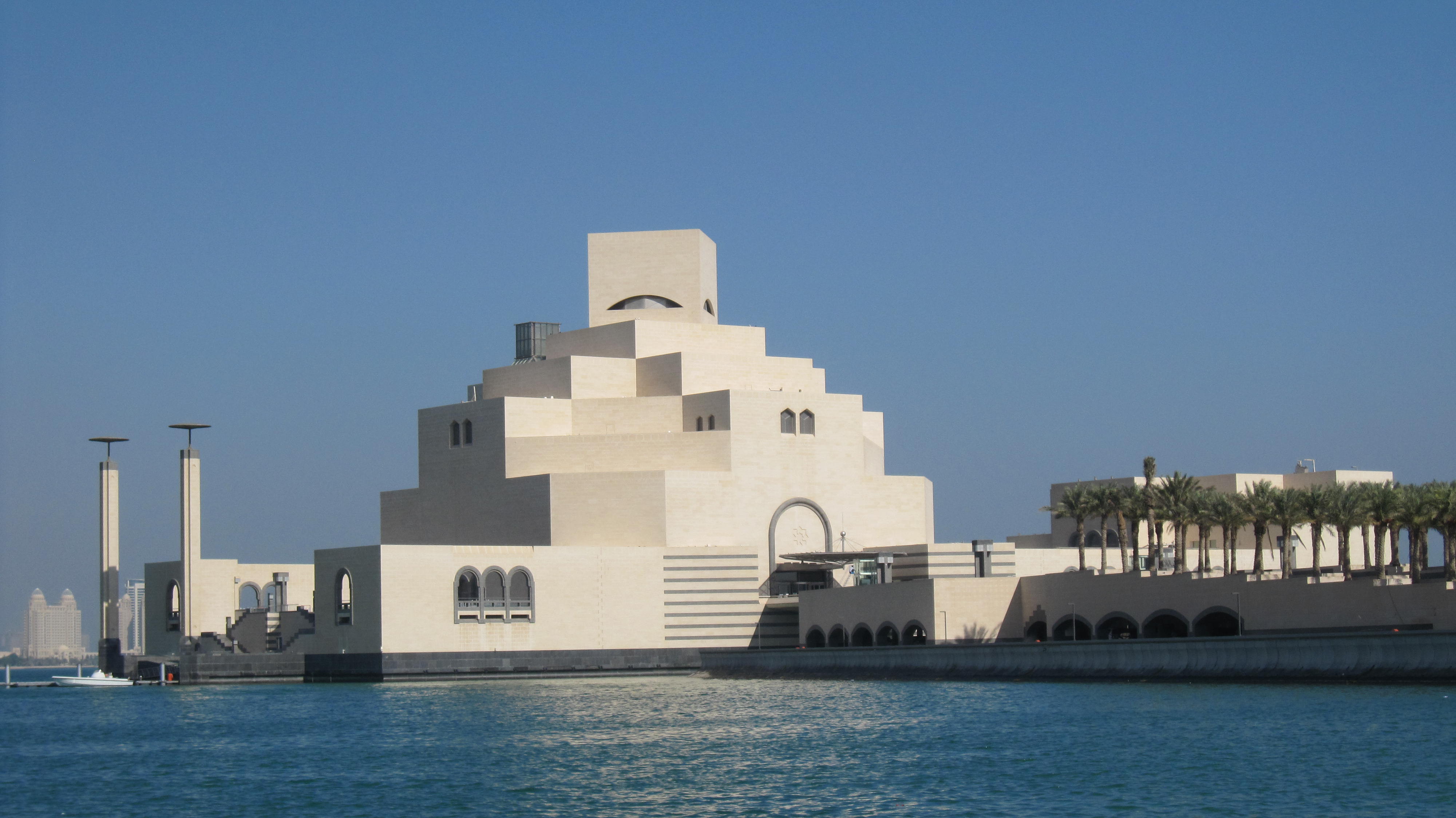
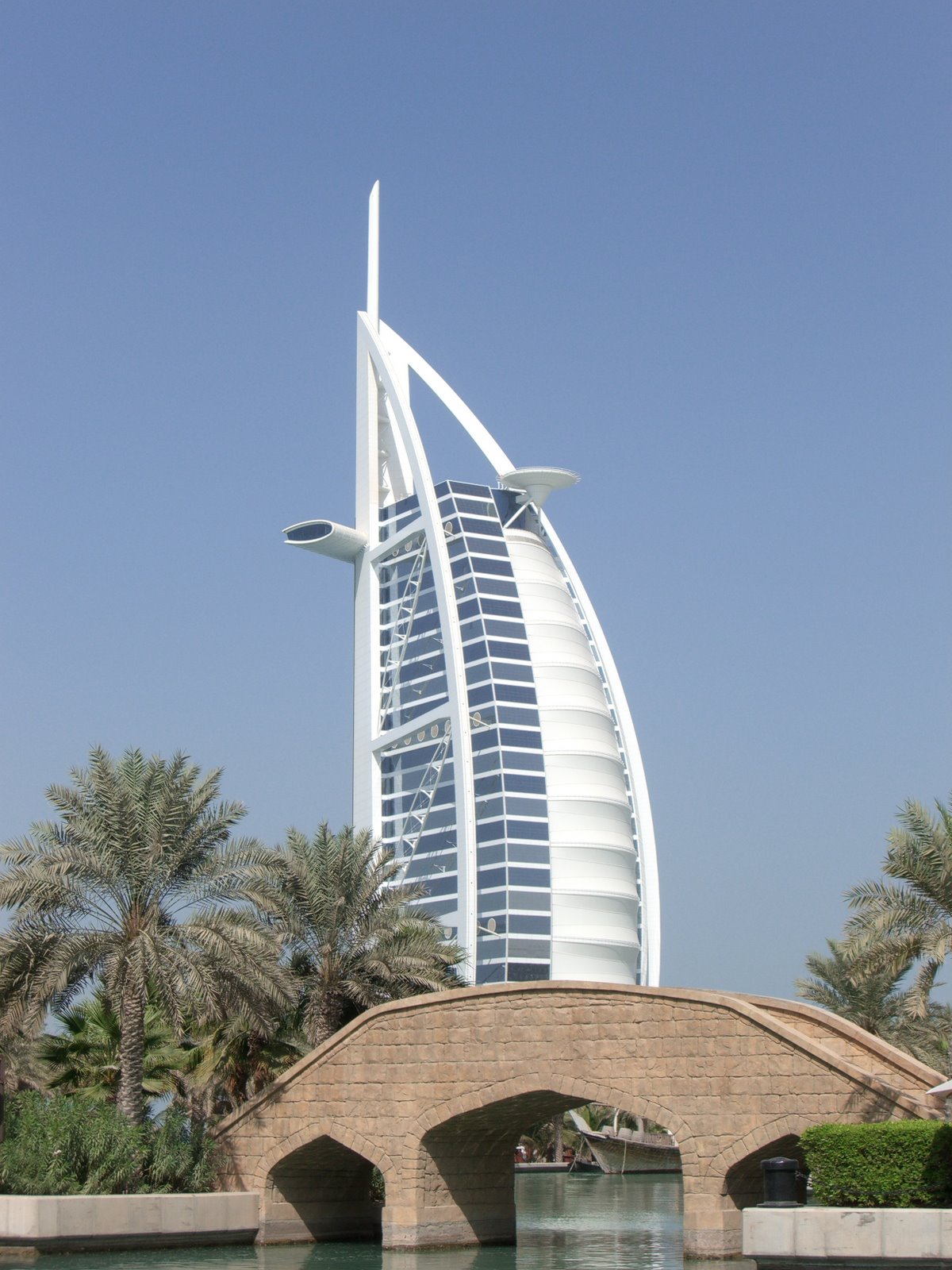
The Present: My previous posts have alluded to the impressive energy and imagination fueling the emergence of Dubai and Qatar as cosmopolitan international centers. Nowhere is that spirit more evident than in the bold, innovative architecture in these cities.  The pictures below tell the story.  These gleaming steel and glass buildings, in such extraordinary shapes, make a striking contrast to the limestone, coral and mud structures of olden days. When known, the architect’s name is in the caption on the photograph, which you can read by moving your cursor over the image.
The Future:  In December 2010 Doha was awarded the World Cup for 2022.  Most people on the planet are skeptical that they will be able to pull this off, this miniscule dot of a country, with summer temperatures of over 125 degrees Fahrenheit! Well, here are just a few of their plans, already underway: lodging for tourists on floating hotels off the Pearl Island; free public transportation throughout the city on a “People Mover”; covered stadiums made comfortable by vast cooling systems and remote control clouds (stadiums which they will then fold up and donate to Third World countries).

Big dreams. Smart ideas.  I, for one, hope they succeed, especially if they are sensitive to the environment as they proceed. If they do, we are all winners. Look at the pride on this young girl’s face on Qatar National Day soon after the awarding of the  World Cup!       Next Post: Wandering through Bastakia
Cocktails Anyone?

“The Sheikh, being much concerned over the risk his family was running in the plague-stricken town, had taken the precaution of having in six bottles of brandy, the most convenient medicine he could obtain….But on one luckless night, when his wife happened to enter there, she espied the brandy lurking in a dark corner. Being a lady of marked religious convicitions, she at once called to mind the words which the Prophet has pronounced against alcoholic liquors, and without much ado opened the bottles and poured out their contents upon the floor.”

Gertrude Bell, 1894

I forgot the sixth most frequently asked question. (See the January 23 Post, Five Frequently Asked Questions) Can expats drink alcohol in Muslim countries like Dubai and Qatar? The answer is a simple yes. Explaining how and where is more complicated.

Muslims are not supposed to drink alcohol. As to whether they actually abstain, I cannot speak from firsthand experience, as I have never been with a devout Muslim in a situation where he or she might be tempted to partake. On the other hand, secondhand sources, such as contemporary memoirs and novels as well as anecdotal evidence shared by our friends here, indicate that many do indeed drink alcohol- some heavily- in the privacy of their homes. I have heard it said that they even go to the bars where westerners flock, but they are not wearing their Arab attire when they are there. Muslims incognito, so to speak.  My guess is that adherence among Muslims to this religious commandment is not unlike Christians, Jews, Buddhists, and Hindus to theirs: inconsistent and certainly not universal. Gertrude Bell’s remark above refers to a visit to Persia, where the rules were not as strictly enforced. For example, on several occasions she mentions the “fragrant wine of Shiraz” and “the choicest of the forbidden juices of the grape”. Throughout the narratives  of  Thesiger and Stark, who travelled almost wholly in the Arabian Gulf, on every social occasion they drank weak hot tea, camel milk, and cardamom flavored coffee. Never a mention of alcohol.

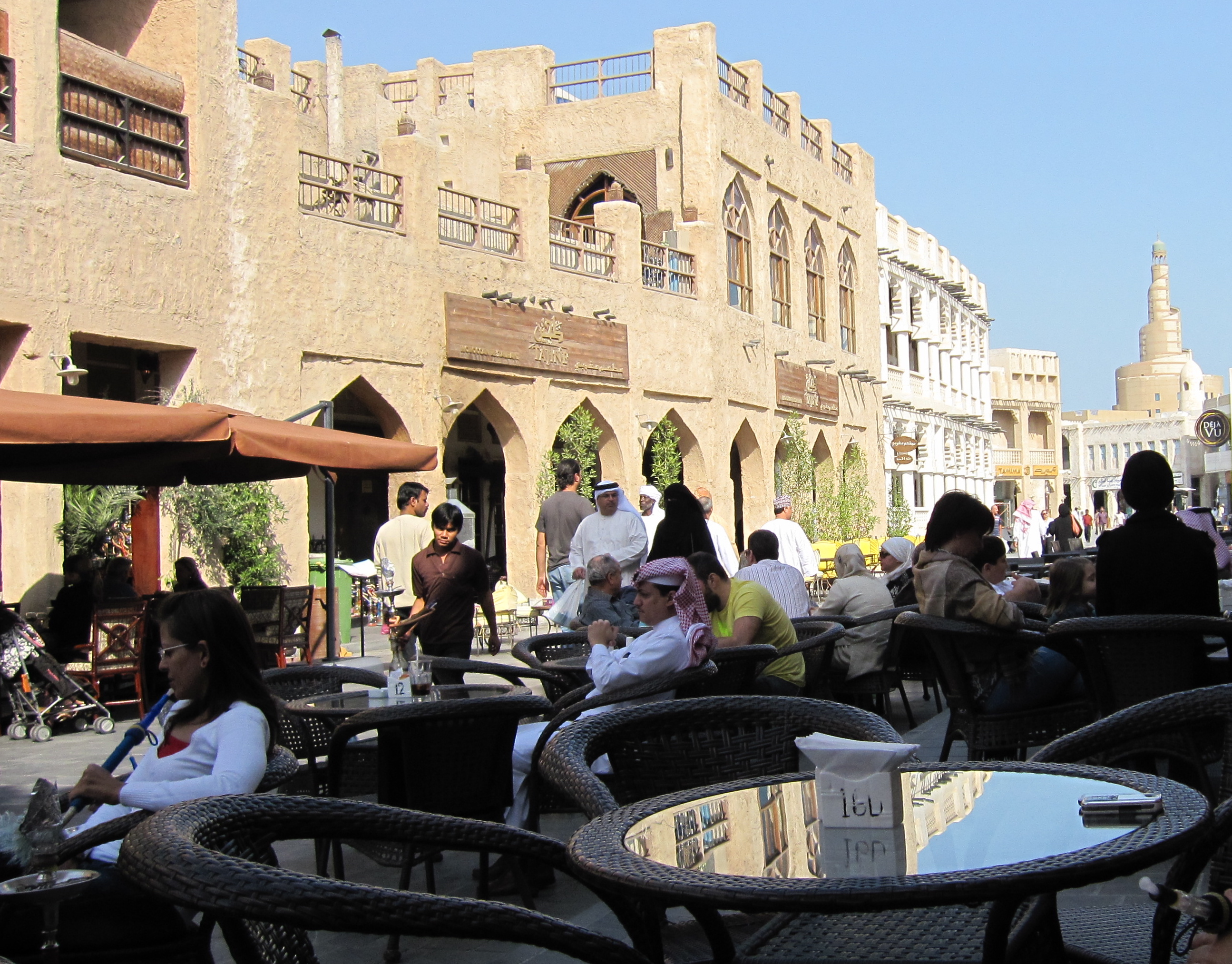
On a related note, in public settings, Muslims, both men and women, enjoy smoking shisha or hookah pipes, sometimes known as Hubbly Bubbly. Tourists often assume they are smoking marijuana, but this is not the case. The smoke is flavored with herbs “made to order”. It is a rather elaborate process, involving combining herbs and tobacco, heating water in a glass container, and connecting long tubes to a pipe. The pipe is usually shared among friends and family members, and it is an enjoyable, relaxing social custom among Arabs. I often see groups of women out together smoking shisha pipes, laughing and trading tales. These Arab women get just as lively as we American women do, all talking at once!

Back to alcohol. Expatriates in both Dubai and Doha must first go through a lengthy process to obtain Residency Permits. Without those, you cannot do anything. You cannot even stay here for more than a month. For Dubai, I had to go through multiple hoops, including trips to the US State Department AND the courthouse in the capital of the state where we were wed for new official signatures on our original marriage certificate, to prove I am actually married to my husband, since he was “sponsoring” me. But that is another story.

Only after you have your Residency Permit can you apply for a License to Purchase Liquor. In Dubai, there are liquor stores tucked in out-of-the-way places behind certain grocery stores. They don’t make it easy! You have to really want it in order to go to the trouble to buy it!  As for places to drink, restaurants in hotels and other mostly expat areas, like Palm Jumeirah, serve alcohol. Dubai markets itself as a tourist destination, so it is fairly accommodating as it woos international travelers who want to shop in the up-scale stores and frolic on the beach. BUT do not drink on the beach! There is a limit to the government’s tolerance, and drinking outdoors in public areas is simply not permitted.

Qatar is a more conservative Muslim country, focusing on education, sports and the arts more than finance and tourism. Only restaurants in international hotels serve alcohol, along with those “off-shore” on the Pearl Island.  And, up until recently, there has been only one liquor store in the entire country. That’s right. One. And it is in the middle of the desert, right next to the non-descript building that serves as the Catholic Church. Intentional? Probably. Qatar is in the process of building a liquor store on The Pearl, so that makes a grand total of two.

Procuring an Alcohol License in Qatar is an even longer, more involved process than in Dubai. Among other things, your employer has to write on the form how much money you earn each month. How much alcohol you are allowed to purchase depends on how much you earn. Some assume that this is an attempt to prohibit the migrant workers from becoming intoxicated.  I do not know. No comment. Needless to say, our allotment, as with all professional expats, is relatively high. Embarassingly so. How much do they think we drink? Whatever the case, on our first trip to this warehouse size store- as well supplied as one anywhere, by the way- we were soon to host an office party. Therefore, we filled a grocery cart to overflowing with bottles of wine, beer, vodka, scotch, etc. We needed assistance from the porter at our apartment to get it onto a trolley, across the lobby, and into the elevator. For the first- and only- time in my expat experiences, I confess I felt a bit like the stereotype of “the brash, showy American…” That has not kept us from going back to the liquor store and having more parties, however!

Next Post: Windtowers to Skyscrapers

Mind Your Manners

“You might think Casablanca’s modern with its chichi stores and ritzy cars, but under that façade it’s raw…it’s tribal. Never forget that.”

Tahir Shah, Caliph’s House

Casablanca. Beirut. Cairo. Dubai. Doha. This comment made by Tahir Shah applies to all the modern cities in the Middle East. Travelers who do forget where they are can face some unpleasantness.  An English couple who engaged in PDA on the beach in Dubai in 2008 was put in jail. Likewise an American acquaintance of ours in Doha who argued with security authorities over some mundane matter. Never has my mother’s message to “mind my manners” been more relevant! At worst, you face incarceration or expulsion for ignoring the rules here- stated and unstated. At the least, you risk being regarded as an uncouth, ignorant American. But this is common knowledge about life in Muslim countries. What about the more subtle codes of conduct?

I attended a workshop with a Cultural Interpreter of sorts, a distinguished and witty Emirati man, who explained expectations for both professional and social situations. There are three key points to bear in mind at all times, the underpinnings of the Gulf Arab society. David Lamb, in The Arabs- Journey Beyond the Mirage, puts it succinctly:

“We are Bedouin. We are tribal. We are Islamic.” 

Desert. Family. Religion. These three strands are woven into the fabric of day-to-day life. First and most important, is an understanding of Islam. Jeremy Williams commented in Don’t They Know It Is Friday?:  

 “A Muslim believes that God’s hand is present in every occurrence on earth. Nothing happens without God ordaining it.”

So when they say “Insha’Allah” (if God wills it), from ordinary conversations to more inflamed, political circumstances, they really mean it. You hear this phrase constantly. From taxi divers: Me-“Please take me to Bastakia.”- Driver-“Insha’Allah.”  From store clerks:  Me- “Do you sell this type of lotion here?” Clerk- “Insha’ Allah.”   From my Iraqi pottery teacher, Zaineb:  Me-“Will this piece be glazed and fired in the kiln by next week?” Zaineb- “Insha’Allah.”  In an interview on Al Jazeerah News: Reporter: “Will the conflict in Bahrain subside soon?” Official- “Insha’Allah.” You get the picture. I do not mean to trivialize this. I have great respect for their open and frequent expressions of faith. They believe that we humans are not in charge, no matter how good our intentions, how careful our plans, and how diligent our efforts.  An unsettling thought. One we recognize as true but would like to forget. Here you can’t.

Professional Settings: So how does this play out in business deals? Well, for starters, do not expect a meeting to begin at the appointed moment- or hour. Do not try to control time (thus, people). Our speaker told us that Arab businessmen find it more challenging to work with “linear” (his words) thinkers as opposed to “circular or global” thinkers. They do not adhere to punctuality and strict agendas at meetings. They do not like to rush, and they do not understand the Western insistence on sticking to scripted “bullet points”. What is the hurry? And what if the dialogue meanders down a different, more meaningful path? Many westerners tend to consider this approach vague, inefficient, and frustrating. More cynical types consider it evasive, even lazy. In my view, it is simply a call to be more patient and more flexible. “Insha’Allah.”

           “Time ceased to be…But somewhere people in offices continued to hold to the illusion of hours…”

Freya Stark, Baghdad Sketches

The Gulf Arabs’ more elastic and fluid sense of time is more than a matter of deference to the almighty power of Allah. It has evolved from their roots in the desert and at sea, where they live by the sun and the moon.  And you see examples of this cultural mindset everyday, all day long. So, I tell myself, ease up, slow down, breathe….

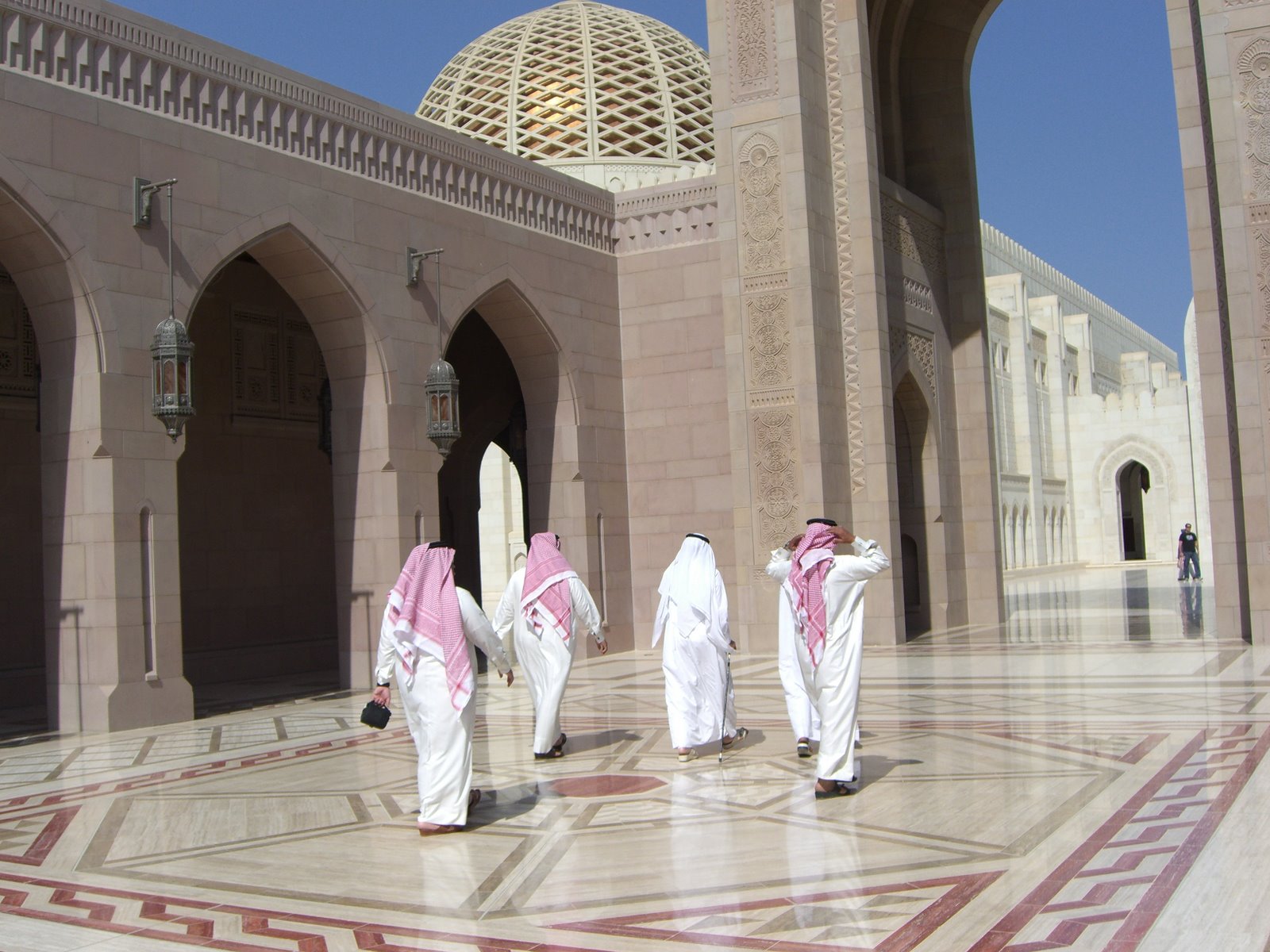
The Bedouin mentality and the focus on family are also evident in business settings. Arabs pride themselves on being hospitable above all else, to both friends and enemies.  The code of honor in the desert is to feed and shelter even hostile visitors for a minimum of three days.  They are civilized, formal and cordial in their dealings.

         “There is always something royal in the manners of the desert.” Freya Stark, Baghdad Sketches

“As long as people call on you, you will prosper, the Bedouin firmly believe, so every person who comes to you deserves a welcome and respect.”          Marguerite van Geldermalsen, Married to a Bedouin

Gulf Arabs consider it rude to begin meetings without first exchanging social greetings, asking about one’s family and general well being. This exchange of pleasantries may last quite a while. And once the meeting finally begins, they have one habit that is surprising- and annoying- to most of us. Since the importance of family over-shadows every other concern among Arabs, they keep their mobile phones on during meetings, answer them, and sometimes have extended personal conversations while the meeting is in session. It would never occur to them to turn off their phones, in case a family member needs them. 

Our teacher made a final point about professional collaboration. It is vital among the Gulf Arabs to honor a person’s dignity. Never embarrass a colleague. “Public praise. Private criticism.” I suspect it can get tricky to discern the line between questioning another’s viewpoint and criticizing him or her. A delicate dance.

Social Settings:  All of the above “rules” apply. Additionally, it is impolite to decline any coffee, food, or gifts offered. Accept their gracious hospitality.

Men should not shake a Muslim woman’s hand unless she initiates the gesture. Also, it is highly inappropriate for a man to compliment the wife of an Arab – “Your wife is so charming, so attractive…”- or for a woman to compliment an Arab friend or colleague’s husband. There are many layers to marital relations and to relations between the sexes in general.  Always true, but especially here.

Speaking of compliments, the most intriguing tip we were given has to do, again, with the Muslim faith. The term “masha’Allah” means, “praise God” or “thanks be to God.” Gulf Arabs do not like to take credit for any good fortune that comes their way, be it financial success, a promotion, a new car, or a handsome watch. They find it offensive to feel proud. In turn, the person giving the compliment might appear envious- quite gauche. So, if you are inclined to comment on a piece of jewelry or an accomplishment, be sure to add “masha’Allah.” For example, “Those are beautiful pearls, “masha’Allah.” The response will be, “Thank you, masha’Allah.” —-You can’t envy God, after all.

So, to sum up:
Be patient.
Count to ten. Or to one thousand.
Be flexible.
Be humble.
Be gracious.
Be discreet.
When in doubt, be quiet.

Thank you, Mother. You were right!  And good manners are, in essence, universal.

I will end this post with one of my favorite sayings, speaking of tuning into nuances and ambiguities, from an amusing little book of Arab proverbs: Apricots Tomorrow compiled by Primrose Arnander and Ashkhain Skipwith

“No answer is an answer.”

Next Post: Cocktails Anyone?

Post Navigation